How to ensure your self-service kiosk solution is favoured by all who use it…
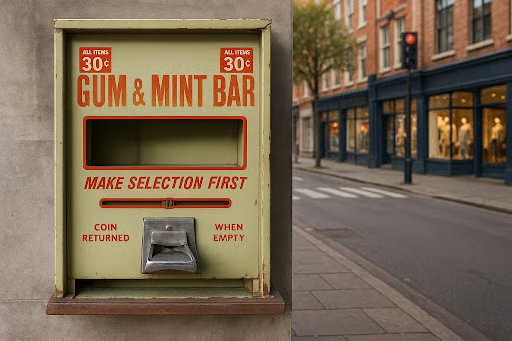
Self service technology has been around us for decades and has been accepted well in simple form. Because the self service process was simple, us humans had no hang-ups with the process, and the self-service subject was more likely to be a whim. I am talking about simple vending machines for bars of chocolate etc.
You choose what you like, put the coins in the machine and pull out the choccy bar. No software or GUI to worry about.
Coins (pennies) were used for these self-service machines and sometimes they got stuck in the mechanism and your choccy bar could not be retrieved. (this problem spawned the expression – “when the penny drops” – after it having got stuck in the mechanism. The expression now has morphed into a euphemism for someone “finally understanding something” – maybe everyone knew that anyway?).
Sorry, I have digressed – back to the now…
Self-service has moved on dramatically from those simple vending machine days. What we want out of self service, or more aptly, what has been presented to us, offers us so much more. But, today’s self service user has to be much more tech savvy to be able to use current day self-service technology. This adds further complication. Needing to be aware of current technology to use self service kiosks is potentially leaving some people behind in their ability to engage with it, or as importantly, their wish to do so.
Coinage and notes are becoming less and less used in self service technology these days, most use debit/credit cards or phone / watch tap when payment is involved.
When self service technology gets a bad name:
Where coinage and notes are still used for self service payment (think NHS car parks etc) there is often a good deal of frustration involved in its use. This leads to self service technology getting a bad name which could easily be avoided. Asking the general public to use notes and coins at a kiosk to access public services creates difficulty at the point of use. Often there is a queue building up behind the user trying to use notes where the queue becomes frustrated for the wait involved.
This same bad name is equally applicable where paying at a kiosk requires an app on a mobile phone to be accessed. In popular places a huddle of people can often be seen, all accessing their mobile phones trying to pay for parking at a kiosk where an app has to be accessed. Generally, the air is blue with the conversations surrounding this kind of self service technology.
I recently witnessed an example of self service frustration at an NHS hospital, when collecting a member of my family. I joined the self service kiosk queue to pay for parking at the hospital. At the head of the queue was a middle aged man attempting his payment for the third time – using cash in the form of notes. The kiosk was out in the open experiencing all weathers and whilst the designer’s intention was to enable all methods of payment, it was clear that paying by notes was fiddly and not working well.
The man became frustrated at the “new self service technology” not working. The rest of the queue, including me also became frustrated because of the delay. Self service is supposed to be quick and easy, but so often it leads to delays and multiple frustrations.
Incidents like this show several important things for today’s self service world:
-
We all want immediate service.
-
But, we are not prepared to queue for long.
We are ok with Self service – as long as it works with minimal fuss: AND there is no learning curve to be done in the cold and rain.
Designers of self service technologies and software should put themselves in the shoes of the disinterested user for a reality check on what they present us:
The average kiosk user is not interested in the super software coding, nor the amazing styling of it. The user is only interested in the service, and they want it without fuss, drama, software training or technical hitches.
As self service technology offers increasingly more complex services, the designers have an increasingly difficult job to design solutions for the vast majority of users who do not want a technology lesson when accessing self service kiosks
In the parking instance I described above, the chances are that if the cash option had been removed, there would not have been a queue or frustration. The negative conversations in and around the queue towards the unfortunate user, the technology, the owner of the service and its designer would not have happened.
The waiting and difficult experiences get chalked up to a bad rap for public facing self service technology.
Keeping the process simple to understand and use is the cornerstone of well accepted self service technology.
Self service technology is not a personal technology like a phone is. The best reputation a kiosk gets is a neutral “it did the job OK” kind of reputation when all goes smoothly. But unfortunately, the lasting reputation will be the one surrounding the one with a long queue, the one with the confusing process, the one that was “out of order” or my example above.
The “take away” is that organisations that offer self service tech for their customers, really need to take stock of what they include in the design. technologies and processes must be simple in nature by not being fiddly, hard to understand, lengthy in process or needing specific app knowledge, just to offer simple services like parking or check-in or way finding
Making self service technology a dream to use for all-comers is a holy grail for us, and one we spend much time in advising all our clients, present and future.
Written by

Nick
You may also interested in:

How Clinics Can Reduce Patient Waiting Times Without Hiring More Staff
Walk into almost any busy GP surgery or clinic at peak time and you’ll see the same thing: a full waiting room, a queue forming at reception, phones ringing, and
How Much Does a Self-Service Kiosk Actually Save?
For many businesses considering automation, the first question is simple: does a self-service kiosk actually save money? The short answer is yes – often far more than expected. But the
Contactless Hospitality:
Why Modern Guests Prefer Self Check-In
The hospitality industry has changed dramatically in the last few years. Guest expectations have evolved. Technology has matured. Labour costs have risen. And the demand for speed, convenience and privacy
What to Look for When Choosing a Business Kiosk
(Avoid These Costly Mistakes) When businesses choose a kiosk, the decision often starts with hardware: screen size, price, specifications. That approach is where most mistakes begin. In reality, the success
The Hidden ROI of Self-Service Kiosks
What Most Businesses Don’t Calculate When businesses assess self-service kiosks, the calculation is usually simple: hardware cost vs. staff savings. That view misses the bigger picture. In reality, most of
Enduring Customer satisfaction needs kiosk technology PLUS the human connection
Self-service kiosks for increasingly complex tasks need the human support to aid the customer where needed. Great customer satisfaction will only be achieved with the speed of the kiosk and
The Silent takeover of everyday spaces
An exposé of how, where and why touchscreen kiosks are and will increasingly be found in every part of life The Silent Takeover of Everyday Spaces In airports, restaurants, shopping
Getting value!
Maximise the Return on Your Self-Service Kiosks Most self-service kiosks are installed with a clear purpose—to deliver a specific service efficiently and with scale. To help users identify that purpose,
Customer Happiness is the New Currency of Business
Today, using self service kiosks to provide quality and reliable services is a key part of creating happy customers that keep returning. Happiness in today’s marketplaces is often measured by