The Zero-Risk Clinic: Swiftqueue-Integrated Kiosks Solve the NHS Compliance Minefield
June 24, 2026 by Nick
Self service automation is no longer a luxury for UK blood, radiology and other test clinics – its a fundamental necessity. With patient numbers rising clinic and practice managers need to manage patient flow without using the very staff required to attend to the patients. Self-service check-in kiosks are the obvious answer to freeing up staff and killing waiting room queues
However, introducing new technology into a clinical environment needs careful management.
An efficient and fast flowing waiting room using self service technology must be universally accessible, data secure and clinically safe as attested by passing a Care Quality Commission (CQC) inspection. Failing a CQC inspection will involve some patients being excluded in the technology and staff attending to check-ins and not the patients.
If you are looking to upgrade your clinic’s reception workflow, you cannot just buy a basic digital screen. You need a ready made compliant solution. Combining self-check-in hardware, designed especially for speed and volume with the Swiftqueue software solution offers the best volume self check-in capability “out of the box”. It also eliminates regulatory risk – completely.
1. The Software Hurdle: Why Swiftqueue Integration is Non-Negotiable
The biggest headache for any healthcare IT manager or clinical director when introducing hardware is compatibility. If a self-service kiosk cannot seamlessly talk to your core appointment and scheduling databases in real time, it is an unusable system that will never be purchased.
This is where the software power house comes in. Swiftqueue is an enterprise-grade scheduling and patient management platform trusted across dozens of NHS Trusts and private clinics nationwide.
By using hardware designed to run Swiftqueue natively out of the box, you eliminate the risk of custom API headaches, data syncing lag, or local data caching vulnerabilities.
It offers:
- Real-Time Patient inclusion & Validation: Patients check in, and their arrival status is instantly flagged on the clinical team’s dashboard.
- Unlimited Patient volume: Patient volume is then limited only to the number of patients the clinic can review in a day, not the check-in bottle neck of manual check-in
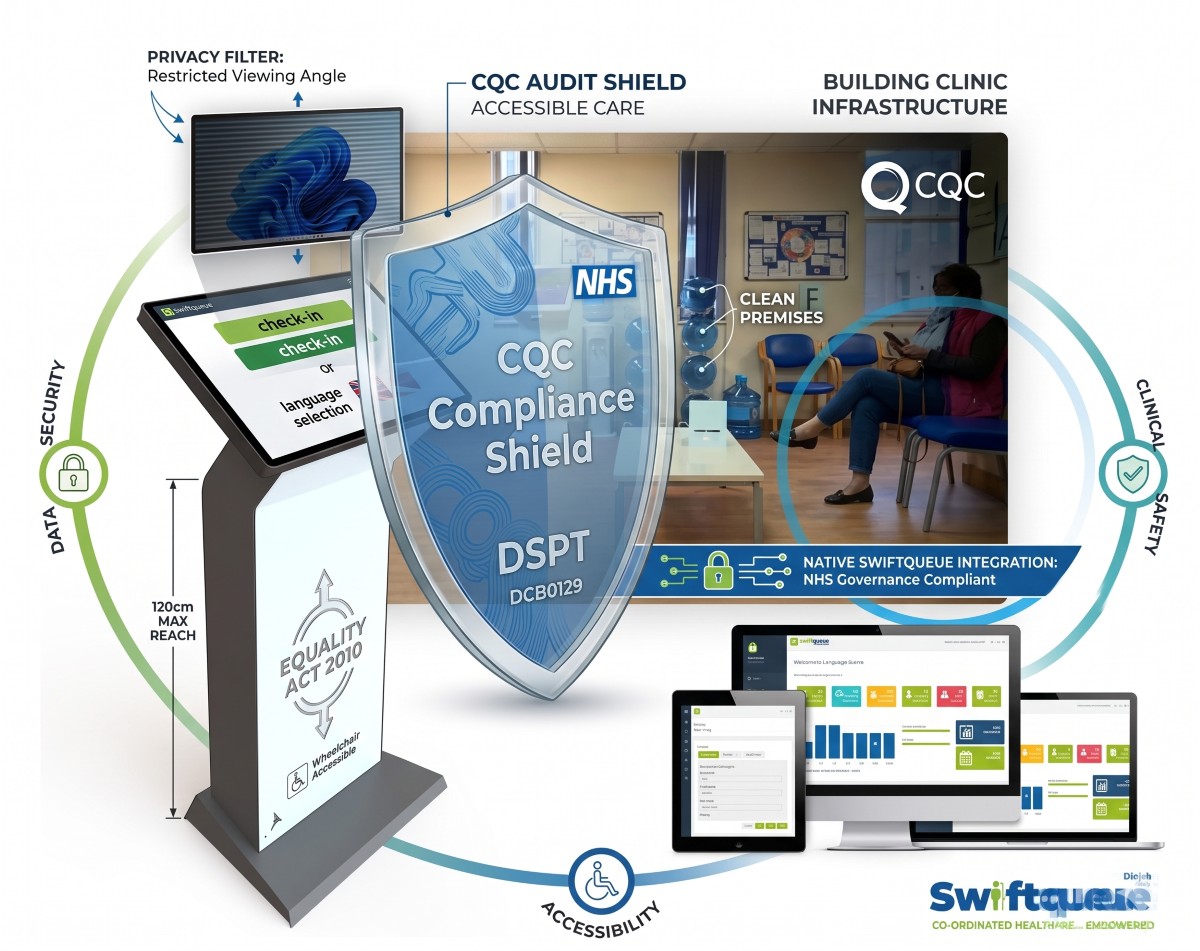
- Information Governance: Data flows securely through approved NHS channels without ever being stored locally on the physical kiosk device, fully satisfying the Data Security and Protection Toolkit (DSPT) mandates.
When your hardware is built specifically to house the software the NHS already trusts, the technical gatekeepers can sign off on deployment with absolute confidence.
2. Physical Versatility is an Accessibility Law (Equality Act 2010)
Compliance isn’t just digital; it is profoundly physical. Under the Equality Act 2010, healthcare providers have a strict legal duty to make “reasonable adjustments” to ensure disabled patients are not excluded or disadvantaged..
A one-size-fits-all patients kiosk is a major compliance liability. True inclusivity requires a modular approach to hardware design, allowing the physical device to adapt perfectly to the layout of the space:
- Wall-Fixed Modules: These can be mounted at the precise legal height and angle required for independent wheelchair access and comfortable reach.
- Desktop Units: Perfect for placing directly onto low-level reception desks, allowing patients to complete their check-in comfortably while seated.
- Freestanding Pods: Engineered with ergonomic tilts, anti-glare screen treatments, and high-contrast UI displays to support elderly patients or those with visual and cognitive impairments.
By choosing modular hardware, versatility ceases to be just a design preference – it becomes the mechanism by which you guarantee that no patient is digitally excluded.
3. The CQC Shield: Protecting Patient Dignity
When the CQC inspects a healthcare practice under its core assessment frameworks, they look closely at whether services are Responsive and Caring. Specifically, Regulation 9 (Person-centred care) and Regulation 15 (Premises and equipment) dictate that digital tools must support, rather than degrade, patient dignity.
If an inspector observes vulnerable, elderly, or non-English speaking patients standing confused and abandoned in front of a complicated digital screen, the practice will be flagged.
A Swiftqueue-integrated kiosk acts as a compliance shield by removing the front desk check-in staff role. Greater than 80% of routine check-ins can reliably be serviced by the self service screens. It means that your nursing staff are instantly liberated from check-in duties. They are no longer buried under manual data entry, repetitive phone lines, or matching names to appointment cards.
Instead, they are providing intensive, patient care and testing and face-to-face, human-centric support to the patients who actually need it.
The technology handles the data; the nurses handle the care!
4. Privacy in Public Spaces
Patient confidentiality is paramount. In a crowded waiting room, the physical layout of a kiosk can accidentally expose sensitive patient information (like names, dates of birth, or appointment types) to other people close by.
To remain compliant with strict data privacy laws and clinical governance, the physical hardware must protect the user’s data and private information.
Integrated security: High-tier clinical kiosks can be specified with micro-louvre privacy screen filters. These restrict the viewing angles so drastically that only the patient standing directly in front of the terminal can read the text on the screen, keeping data hidden from anyone “shoulder surfing” close by. All K4B kiosks can be supplied with integrated privacy screens.
Don’t Just Buy a Screen – Buy Infrastructure
When your patient volume has increased to the point where you need automation, look past the simple thought of a digital tablet.
Your practice, your staff, and your patients, need a solution that treats compliance as a baseline requirement whilst offering volume self check-in. By deploying K4B premium, modular hardware that is pre-configured for the nationally approved Swiftqueue platform, you build a volume clinic infrastructure that works from day one, and is fully compliant forever.
Written by

Nick
You may also interested in:

Every Second Counts: How K4B Visitor Management Kiosks Deliver One-Click Emergency Evacuation Lists
When an emergency alarm sounds in a busy facility, the most critical question appointed fire marshals face is immediate and urgent: Who is currently in the building? While permanent staff
Beyond the Clipboard: Why Modern Clinics Are Moving to Self-Service Patient Intake
Every morning in busy medical practices and outpatient centers, the same scenario plays out: patients queue at the front desk, balancing clipboards, insurance cards, and pens, while administrative staff manually
How the Right Visitor Management Kiosk Creates Unexpected Business Value
In a busy office block, factory, conference centre, hospital etc. managing the people coming into the building is a significant task. Before the K4B Visitlog solution, a delegation of receptionists
The Digital Triage: Why Integrated Self-Service Kiosks are the Future of Medical Administration
In the high-stakes environment of modern healthcare, the reception desk is often the primary point of friction. Between emergency admissions, scheduled consultations, and a steady stream of pharmaceutical representatives and
How Clinics Can Reduce Patient Waiting Times Without Hiring More Staff
Walk into almost any busy GP surgery or clinic at peak time and you’ll see the same thing: a full waiting room, a queue forming at reception, phones ringing, and
How Much Does a Self-Service Kiosk Actually Save?
For many businesses considering automation, the first question is simple: does a self-service kiosk actually save money? The short answer is yes – often far more than expected. But the
Contactless Hospitality:
Why Modern Guests Prefer Self Check-In
The hospitality industry has changed dramatically in the last few years. Guest expectations have evolved. Technology has matured. Labour costs have risen. And the demand for speed, convenience and privacy
What to Look for When Choosing a Business Kiosk
(Avoid These Costly Mistakes) When businesses choose a kiosk, the decision often starts with hardware: screen size, price, specifications. That approach is where most mistakes begin. In reality, the success
The Hidden ROI of Self-Service Kiosks
What Most Businesses Don’t Calculate When businesses assess self-service kiosks, the calculation is usually simple: hardware cost vs. staff savings. That view misses the bigger picture. In reality, most of